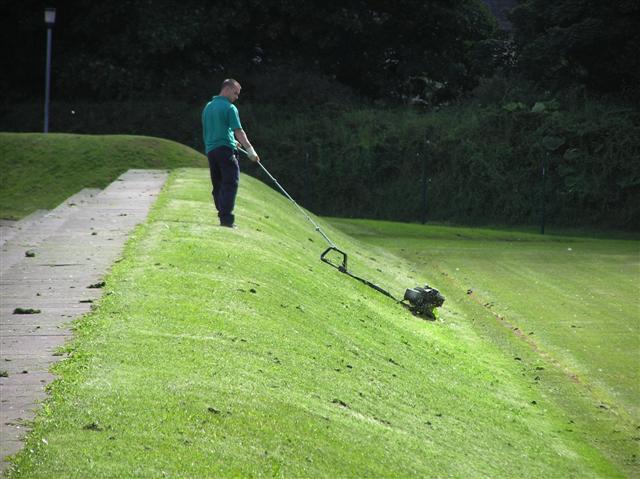
Mowing is the single maintenance task performed most frequently on any lawn, and the decisions made — how short to cut, how often to cut, and what to do with the clippings — have a greater cumulative effect on turf health than almost any other input. Errors in mowing practice compound over a season; correcting them mid-year is harder than setting the right parameters from the first cut.
The One-Third Rule
The most consistently supported principle in turf management is the one-third rule: never remove more than one-third of the current leaf blade height in a single mowing session. Removing more than one-third causes scalping, forces the plant to draw on root reserves to regenerate leaf area, temporarily halts root growth, and leaves the surface open to weed and moss invasion while the turf recovers.
In practical terms: if your target cutting height is 4 cm, mow before the grass reaches 6 cm. If you miss a cut and the lawn reaches 9 cm, raise the deck to 6 cm for the first pass, then return to 4 cm after 5–7 days. Never drop from 9 cm to 4 cm in a single session.
Spring after a long winter: the first mow of the year often finds grass that has grown unevenly or laid flat under snow. Set the deck high — 6–7 cm — for the first two cuts of the season, regardless of your summer target height. This reduces stress on turf that has been through winter dormancy and avoids removing crowns that are still recovering.
Recommended Cutting Heights by Season
| Season / Period | Target height (cm) | Rationale |
|---|---|---|
| Early spring (April) | 5.0–6.0 | Post-dormancy recovery; high deck reduces stress |
| Late spring (May–June) | 3.5–4.5 | Peak growth period; standard height for ornamental lawns |
| Summer (July–August) | 5.0–6.0 | Higher cut shades soil, reduces moisture loss, protects roots during heat |
| Autumn (September–October) | 4.0–5.0 | Slight reduction from summer height; maintain into final cut |
| Last cut of the year | 4.0–4.5 | Avoid cutting below 4 cm before winter; long grass flattens under snow and promotes snow mould |
These ranges apply to mixed cool-season lawns dominated by fescue and ryegrass — the composition of the majority of residential lawns in Poland. Lawns seeded primarily with smooth-stalked meadow-grass (Poa pratensis) tolerate slightly lower heights (down to 2.5–3 cm) once established, but recover more slowly from scalping.
Mowing Frequency
Frequency depends on growth rate, which changes substantially through the season:
- May–June: grass grows most rapidly. In a warm, wet season, cutting twice per week may be necessary to stay within the one-third rule at a 4 cm target height. Once per week is the minimum for this period without allowing the lawn to become overgrown.
- July–August: growth slows during the hot, dry period. One mow every 10–14 days is often sufficient, and less frequent mowing (combined with the higher summer deck height) reduces heat stress.
- September–October: active growth resumes as temperatures cool. Return to weekly mowing until growth slows visibly in late October.
- November onward: mow only as needed. Once average daytime temperatures stay below 8–10 °C, growth stops and the lawn enters dormancy. The final mow should be completed before the first hard frost.
Blade Sharpness
A dull blade tears rather than cuts the grass blade. Torn tissue creates a frayed white tip that turns brown within a day or two, giving the lawn a straw-coloured appearance even when the grass is healthy. Torn tissue is also significantly more susceptible to fungal infection, particularly Rhizoctonia and Helminthosporium species that cause common summer diseases in Polish conditions.
Mower blades should be sharpened at a minimum once per season for low-use domestic mowers and every 20–25 hours of operation for machines used on larger areas. Sharpening at the start of the season before the first cut is a basic step that disproportionately improves cut quality.
Clipping Management
Short clippings (less than 2.5 cm in length) left on the lawn surface after mowing decompose quickly and return nitrogen to the soil, reducing fertilizer demand by an estimated 20–30% over the season. This practice (known as grasscycling) is effective when the lawn is mowed frequently enough that clippings are short and do not clump.
When the one-third rule has not been followed and clippings are long, they should be collected. Long clippings mat on the surface, block light, and create conditions for fungal development underneath. Collected clippings can be added to a compost pile as a nitrogen-rich green material, layered with carbon-rich brown material such as dry leaves.
Mowing Patterns and Compaction
Repeating the same mowing direction every session causes subtle soil compaction along the wheel tracks and can create a corduroy pattern in the turf. Rotating the mowing direction by 90° on alternate sessions — or alternating diagonal passes — distributes wheel traffic and produces a more uniform surface. On small domestic lawns this makes a measurable difference to compaction levels over a season; on larger areas it is essentially mandatory.
Wet Conditions
Mowing on saturated ground compacts soil, tears roots, and causes mower wheels to leave deep ruts. In Poland's spring season, when the soil is often wet from snowmelt well into April, it is worth waiting for two consecutive dry days before cutting rather than forcing the issue. If the lawn must be mowed in wet conditions, keep the deck high and avoid tight turns.

